

Short answer: A dishwasher that is not heating usually has one of six problems: the hot water reaching it is not hot enough, the heated wash or dry option is off, the heating element has burned out, the high-limit thermostat or temperature sensor has failed, the control board is not sending power to the heater, or a clogged filter is holding back water. Start with the hot water and cycle settings. If dishes still come out cold, call (830) 240-5230.
You open the dishwasher at the end of the cycle and the dishes feel cool, there is a greasy film on the glasses and water is pooled on top of every cup. Heat does a lot of the work in a dishwasher. It melts grease, activates the detergent and dries the load. When it is missing, cleaning and drying both suffer. In New Braunfels, our hard water makes this worse, because cooler water leaves more spots and film. Here is how to find the cause.
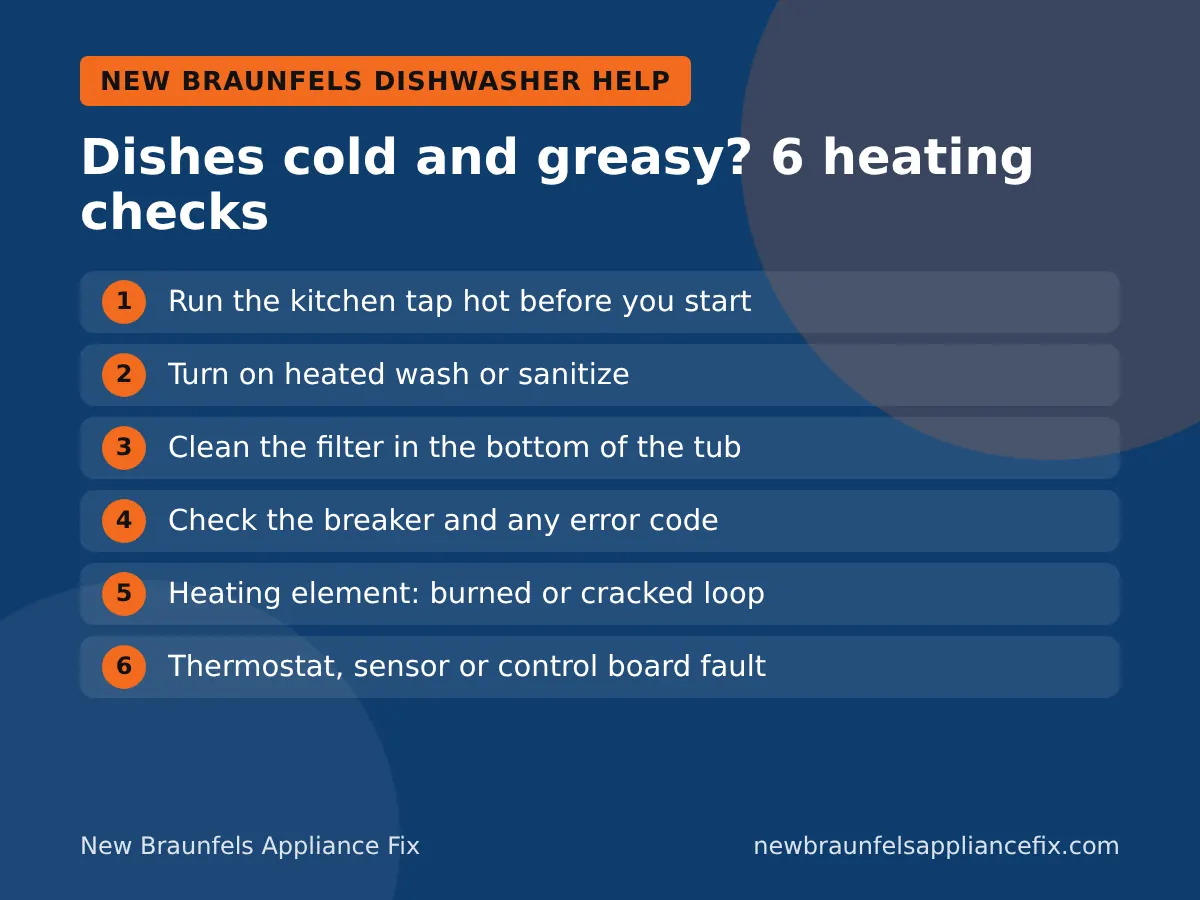
How can you tell if a dishwasher is not heating?
Open the door right after the cycle ends. A working dishwasher lets out a cloud of steam, and the dishes and tub walls feel hot to the touch. If the dishes are cool, still wet and greasy, or the cycle runs far longer than normal while the machine waits to reach temperature, the heater or its controls are likely not doing their job.
- No steam and cool dishes at the end of the cycle.
- A greasy film on plastics and glasses, even with good detergent.
- Cycles that run much longer than usual, or stop with an error code.
- Dishes that come out soaking wet, even on a heated dry setting.
Wet dishes alone can have other causes, like rinse aid or a plastic tub. Our guide to a dishwasher not drying dishes covers those. If the dishes are also cold and greasy, keep reading.
What are the 6 most common causes?
The causes we see most in New Braunfels homes are lukewarm supply water from the kitchen line, a heated wash or sanitize option turned off, a burned-out heating element, a failed high-limit thermostat or thermistor, a control board that no longer powers the heater, and a clogged filter that lowers the water level the heater needs.
- Lukewarm supply water. Many dishwashers expect water at about 120 degrees at the start. If the kitchen is far from the water heater, the first fill is cold. The heater then has to work harder, and on some models the cycle just runs cool.
- Settings. Eco and quick cycles use lower temperatures on purpose. If the heated wash, high temp or sanitize option is off, the dishwasher may never heat the water much.
- Heating element. On most models a metal loop runs around the bottom of the tub. It can burn out or crack. Some newer models hide the heater inside the circulation pump instead.
- High-limit thermostat. This safety part cuts power to the heater if it gets too hot. When it fails open, the heater gets no power at all.
- Thermistor (temperature sensor). The control uses this sensor to know when the water is hot enough. A bad reading can stop heating early or stall the cycle.
- Control board or wiring. The board switches the heater on through a relay. A failed relay or a burned wire connection stops heating even when the element is good.
What can you check before calling for repair?
Start with the easy checks that cost nothing. Run the kitchen faucet on hot until it is hot before starting the dishwasher. Choose a normal or heavy cycle with the heated wash or sanitize option on. Clean the filter at the bottom of the tub. Then run an empty cycle and open the door at the end to feel for heat.
| Check | How to do it | What it tells you |
|---|---|---|
| Hot water at the sink | Run the kitchen tap until hot, then start the dishwasher | If heat returns, the supply water was the issue |
| Cycle and options | Pick normal or heavy with heated wash or sanitize on | Eco and quick cycles run cooler by design |
| Filter | Twist out the filter, rinse it and scrub the mesh | A clogged filter can lower water level and heat |
| Breaker | Make sure the dishwasher breaker has not tripped | No power means no heat and often no start |
| Error codes | Note any code shown on the display | Many codes point straight to a heater or sensor fault |
Hard water scale can coat the heating element and the inside of the pump, which lowers heating. If you see white crust on the tub, read about hard water and a dishwasher that leaves film for steps that help.
When should you call a technician?
Call when the dishwasher still runs cold after the checks above, when it shows a heater or temperature error code, when the cycle runs for hours, or when you smell burning or see scorch marks near the element. Testing the element, thermostat, sensor and board needs a meter and means working near power and water, so it is a job for a technician.
If you are not sure who to call for a broken dishwasher in New Braunfels, our technicians repair Bosch, Whirlpool, KitchenAid, GE, Samsung, LG, Maytag and other brands. We test each heating part, show you which one failed and give you the price before we replace anything.
How much does a dishwasher heating repair cost?
Our diagnostic visit is approx. $90 to $100, and it is applied to the repair if you go ahead. Labor runs approx. $50 to $95 per hour, plus the part for your model. Thermostats and sensors are usually on the lower end. A control board or a pump with a built-in heater costs more. You get the full price before any work starts.
If the dishwasher is over about 10 years old and needs a control board, it is worth comparing the repair price with a new machine. For newer dishwashers, a heating repair is almost always worth it.
How can you keep your dishwasher heating well?
Run the kitchen tap hot before each load, clean the filter every few weeks, use rinse aid, and run a dishwasher cleaner or a cup of white vinegar through an empty hot cycle once a month to break down hard water scale. Keep the bottom rack from blocking the spray arm or heating element.
We serve New Braunfels, Gruene, Canyon Lake, Garden Ridge, Bulverde and nearby Comal and Guadalupe County homes. As the appliance guys New Braunfels homeowners call for every room, we also repair washers, dryers, refrigerators, ovens and garbage disposals.
Frequently Asked Questions
How do I know if my dishwasher is not heating?
Open the door right after a wash cycle ends. The dishes and the inside of the tub should feel very warm and steam should roll out. If the dishes are cool, greasy or still wet, and the cycle ran much shorter or longer than normal, the dishwasher is probably not heating.
Can I fix a dishwasher that is not heating myself?
You can do the first checks yourself: run the kitchen faucet hot before starting, choose a heated wash or sanitize option, and check the breaker. Testing and replacing the heating element, thermostat, thermistor or control board means working with power and water, so it is best done by a technician.
Why are my dishes coming out cold and wet?
Most dishwashers use heat in the final rinse to help dishes dry. If the heating element, high-limit thermostat, thermistor or control is not working, dishes come out cold and wet. A clogged filter or low water level can also lower the temperature.
How much does it cost to fix a dishwasher that won’t heat in New Braunfels?
Our diagnostic visit is approx. $90 to $100 and is applied to the repair if you go ahead. Labor runs approx. $50 to $95 per hour, plus the part for your model. You get the total price before any work starts.
Is it worth fixing a dishwasher that won’t heat?
Usually, yes, if the dishwasher is under about 10 years old. Heating problems often come from one part, like the element or a thermostat. If the main control board has failed on an older machine, compare the repair quote with the price of a new dishwasher.
Get your appliance working again
Call New Braunfels Appliance Fix at (830) 240-5230 or send us a message on our contact page. We will confirm the price before any work starts.
Talk to a local appliance technician today.
Call Now – (830) 240-5230